Prev Post
No previous post available
Land transactions can be a labyrinth of confusing terms, especially when checking records online. In this simplified guide, Genuine Plots unravels key terms, empowering you to make informed decisions and ensuring smooth navigation through the world of land transactions. Let's embark on this journey together, where understanding land records becomes as easy as a walk in the park.
Jamabandi
Nakal
Khata
Khasra or DAG Number
Khewat
Mauza
Bainama
Khatauni
Patta
Khudkasht
Embarking on a land transaction journey can be daunting, but armed with these simplified explanations, you'll be better equipped to decode the complexities of land records.
Prev Post
No previous post available

Buying a plot in Pune is a thrilling achievement, but it's important to understand the hidden expenses that can mount up quickly. There are several additional costs that could significantly impact your budget, in addition to the property's listed price. This thorough guide will assist you in controlling these expenses:
1. Stamp Duty & Registration Fees
Stamp Duty: In Pune, male buyers pay 7% stamp duty on real estate transactions, while female buyers pay 6%. The ready reckoner rate or the market value of the property, whichever is higher, is used to compute this fee.
Registration Fee: Up to ₹30,000 is the maximum registration fee, which is 1% of the property's value.
2. Broker Commission
3. Legal & Documentation Fees
4. Maintenance & Security Deposits for Gated Communities
Maintenance Charges: Annual maintenance fees in Pune's gated communities can range from ₹14,000 to ₹30,000, depending on the amenities provided.
Security Deposits: Some societies may require a refundable security deposit.
5. Utility Connection Charges
Conclusion
Always conduct thorough research and consult with Genuine Plots experts to fully understand the range of costs related to your plot purchase.

It can be challenging to design a home on an irregular or odd-shaped plot, but with the correct inspiration, you can create a stunning and useful space. Here are five clever ways to maximise these kinds of plots.
Use the plot's inherent angles rather than attempting to impose a rectangular design. Curved walls, diagonal balconies, and flowing rooflines can all be used to create a unique and attractive home. You can also add distinctive features with this method, such as spiral staircases or large windows with stunning views.
Break the space into smaller zones for different functions. For example, you can keep the main living areas in the centre and use corners or edges for storage, gardens, or utility rooms. This way, no space is wasted, and every corner has a purpose.
In India, Vastu plays an important role in home design. Make sure your home gets plenty of natural light and air. The kitchen, bedrooms, and main entrance should all be oriented to provide a positive energy flow. A well-planned home will feel cosy and cohesive.
Split-level or multi-story designs can be beneficial if the plot is irregularly shaped or has varying elevations. While living rooms and bedrooms can be found on the upper levels, garages and storage can be found on the lower levels. This adds an intriguing design element and makes the house useful.
Even irregular plots can have great outdoor areas. Courtyards, terraces, or rooftop gardens can fit the unique shape of the land. These areas can become private retreats or spaces for family activities.
Conclusion
It can be challenging to design a house on an irregular plot. But with careful planning, using creative layouts, and taking sunlight and Vastu principles into consideration, you can create a home that is both functional and aesthetically pleasing.

The kind of ownership you have over real estate affects both your rights now and the future value of your investment. Freehold property is by far the safest and most lucrative ownership structure available in India.
But what exactly is freehold, how does it compare to leasehold, and why do buyers and investors prefer it? Let’s break it down.
What is a Freehold Property?
A freehold property means you enjoy absolute and perpetual ownership of both the land and any structures built on it. There are no time limits, no ground rent, and no external approvals required to use, modify, or transfer the property.
Think of it as complete control – once purchased, the property is truly yours.
Key Characteristics of Freehold Property
Advantages of Freehold Property Ownership
Are There Drawbacks?
Cost is the main disadvantage. Generally speaking, freehold properties cost more up front than leasehold properties. Owners are also solely in charge of taxes and upkeep.
Conclusion
Freehold real estate is still the best option for purchasers looking for security, stability, and long-term value. In addition to providing peace of mind, it also ensures that your investment will increase and be retained by your family for many generations to come.
Keep in mind this when deciding between leasehold and freehold: a freehold is a legacy, not just a piece of real estate.

Haaaving to decide between branded and ordinary land? Regular land may appear less expensive, but there are risks involved. Branded land guarantees total peace of mind, long-term value, and security.
You avoid disagreements or hidden liabilities when you own branded land with verified titles and approvals.
From roads to water and power, the branded plots are well-developed. Regular plots usually require additional expenses for necessities.
Branded projects are investments that are future-proof because they are situated close to business districts, schools, and growth centres.
Buying from a well-known brand guarantees dependability, quality, and timely development.
Improved location and infrastructure cause branded land to appreciate more quickly and yield higher returns.
Branded plans have gated security, CCTV, and community amenities that plots don't.
Rainwater harvesting for green parks and branded projects is all about sustainable living and future growth.
Regular land might seem appealing at first, but branded land is a secure, high-return, and future-proof investment that appreciates with time.
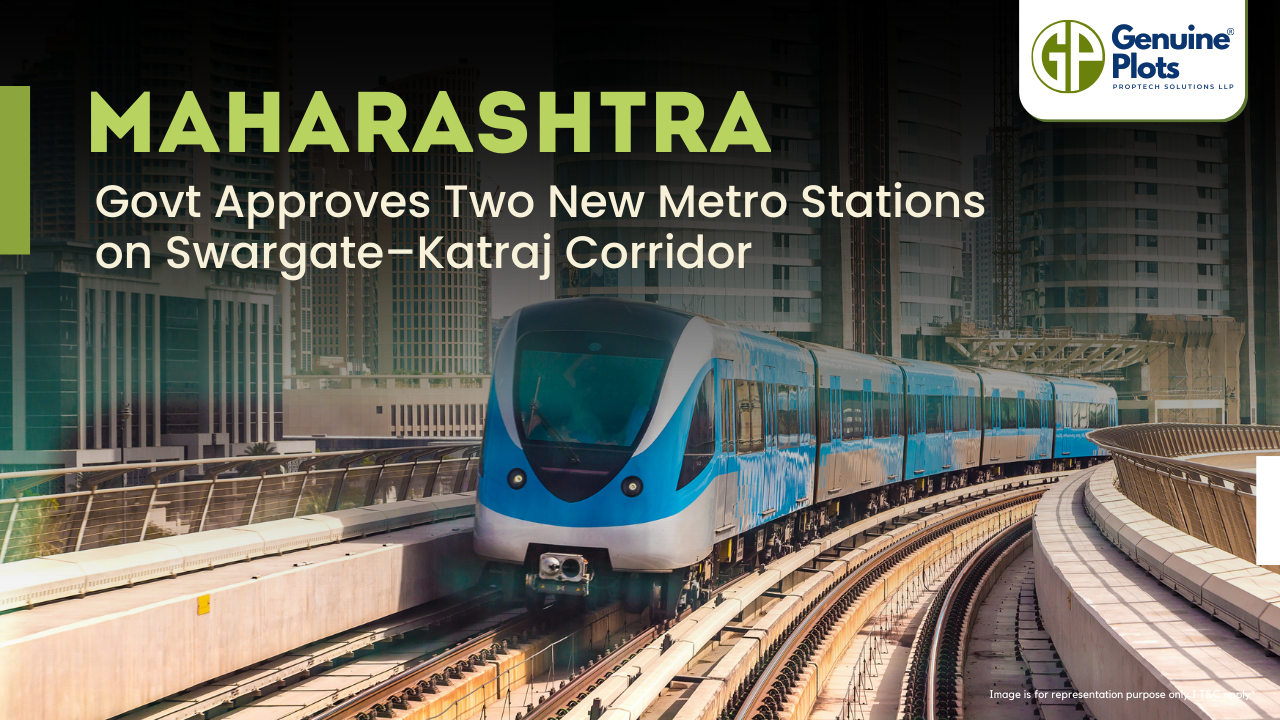
The Maharashtra government has authorised the addition of two new underground stations—Bibwewadi and Balaji Nagar—to the planned Swargate–Katraj metro extension, which is a major development for Pune's metro network.
The decision was finalised during a Cabinet Committee on Infrastructure meeting chaired by Chief Minister Devendra Fadnavis, with Deputy CM Ajit Pawar and Urban Development Minister Chandrashekhar Bawankule in attendance.
Two Key Additions
The 5.46 km underground stretch, known as Line-1B of the Purple Line, was earlier planned with three stations: Market Yard, Padmavati, and Katraj. With strong public demand for better access along the route, the state government has now cleared the proposal for Balaji Nagar (near Bharati Vidyapeeth) and Bibwewadi stations.
Construction Timeline
Though the ground-breaking ceremony for the Swargate–Katraj extension was held in September 2024, actual construction work has been delayed due to retendering. The corridor is expected to be completed within four years of starting, and officials now anticipate contracts to be finalised by October 2025, after the monsoon.
Why It Matters
Traffic congestion along the Satara Road corridor will be reduced once the extension is operational, offering smooth connectivity from central Pune to the southern hub of Katraj. The two newly approved stations are expected to benefit thousands of daily commuters, including students, office-goers, and residents in Bibwewadi and Balaji Nagar.