Prev Post
No previous post available
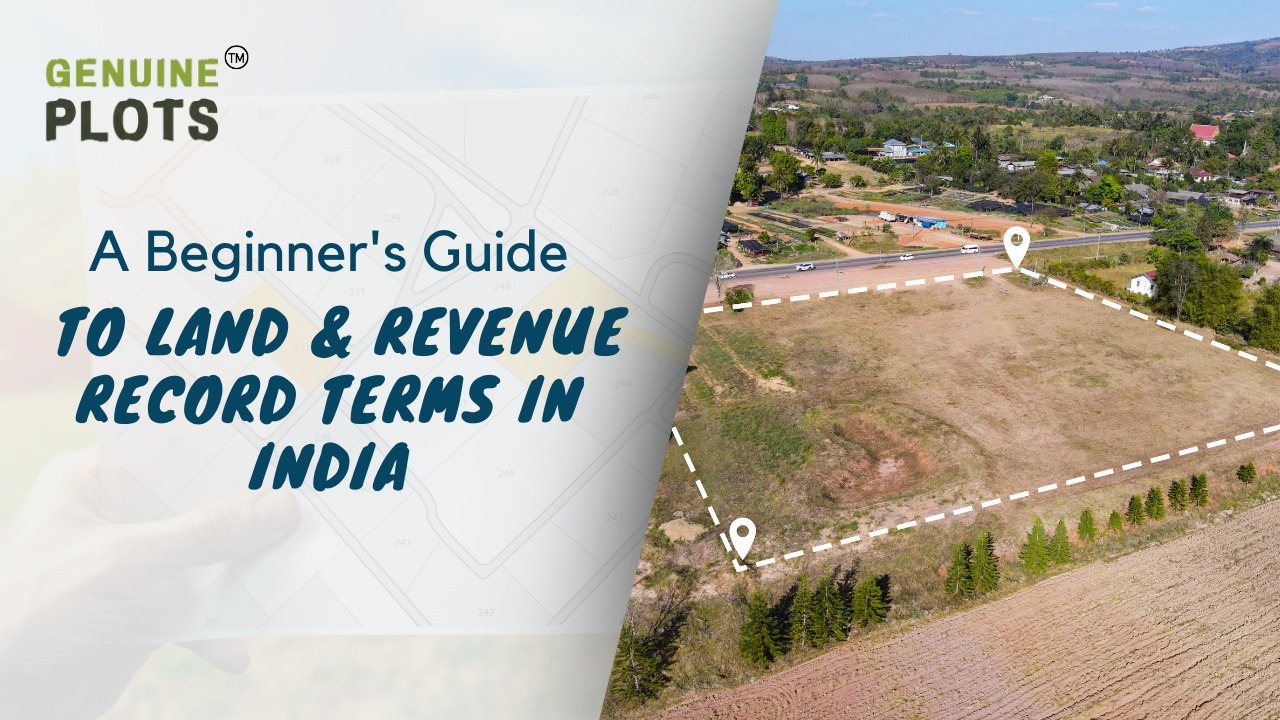
Land transactions can be a labyrinth of confusing terms, especially when checking records online. In this simplified guide, Genuine Plots unravels key terms, empowering you to make informed decisions and ensuring smooth navigation through the world of land transactions. Let's embark on this journey together, where understanding land records becomes as easy as a walk in the park.
Jamabandi
Nakal
Khata
Khasra or DAG Number
Khewat
Mauza
Bainama
Khatauni
Patta
Khudkasht
Embarking on a land transaction journey can be daunting, but armed with these simplified explanations, you'll be better equipped to decode the complexities of land records.
Prev Post
No previous post available

Real estate transactions are legally subject to stamp duty levied by the state government. It serves as proof of ownership and the legality of the sale agreement and ensures that the transfer of property rights is recognised by the law. A real estate transaction is deemed legally invalid if stamp duty and registration fees are not paid.
The Maharashtra government kept Pune's registration fees and stamp duty the same in 2025.
|
Ownership Type |
Stamp Duty (incl. 1% Metro Cess) |
Registration Fee |
Total |
|
Male |
7% |
1% |
8% |
|
Female |
6% |
1% |
7% |
|
Male+Female |
6.5% |
1% |
7.5% |
|
Female+Female |
6% |
1% |
7% |
|
Male+ Male |
7% |
1% |
8% |
Area-Wise Stamp Duty in Pune
|
Pune Areas |
Stamp Duty Rates |
|
Within Gram Panchayat limit |
4% |
|
Within Panchayat or Rural areas under MMRDA |
5% |
|
Within Cantonment area or Municipal Corporation limits |
5% |
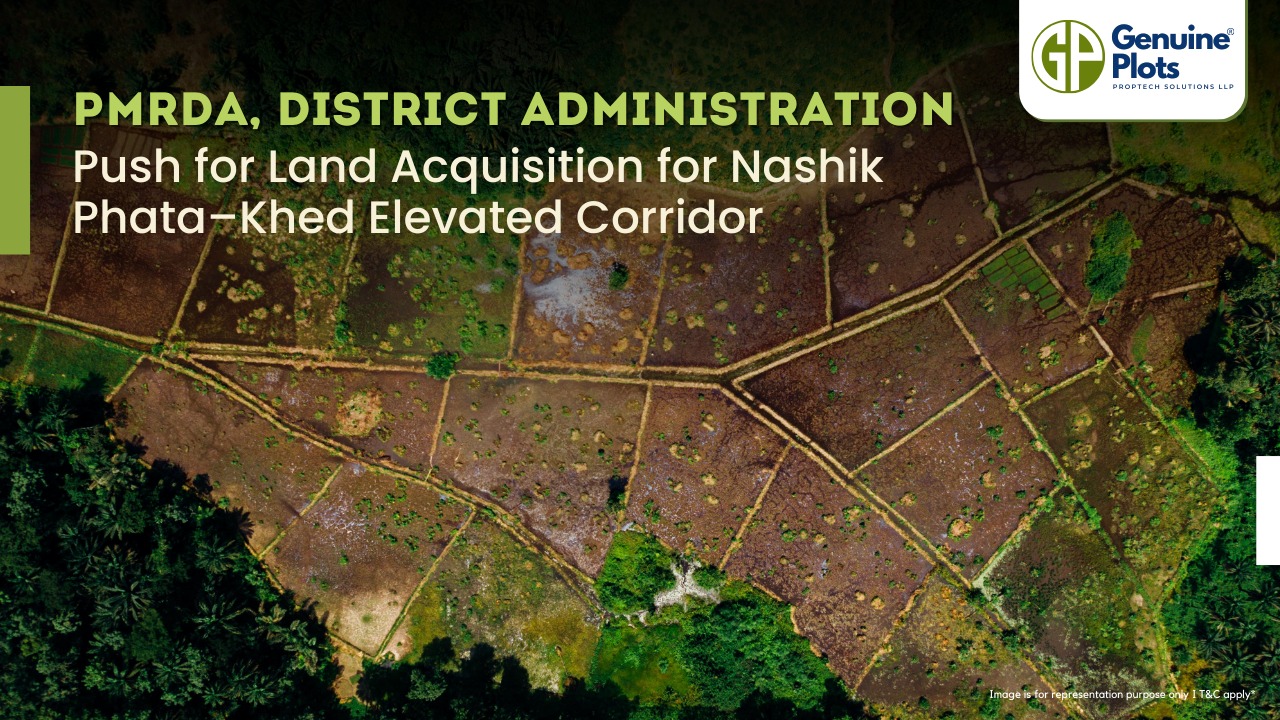
In order to alleviate traffic congestion along the Pune–Nashik highway, the district administration and the Pune Metropolitan Region Development Authority (PMRDA) have stepped up their efforts to finish the land acquisition for the upcoming Nashik Phata–Khed elevated corridor.
Project Overview
The 30-km elevated corridor between Nashik Phata and Rajgurunagar (Khed) will be developed by the National Highways Authority of India (NHAI). The project, estimated at ₹7,827 crore, is expected to significantly reduce travel time and traffic snarls on this vital route, especially near industrial hubs like Chakan.
Land Requirement & Acquisition
Authorities have identified around 14 hectares of land needed for the project, primarily for entry and exit points. Out of this, 9.74 hectares belonging to around 150 landowners within PMRDA limits—covering villages such as Nanekarwadi, Waki Khurd, Waki Budruk, Chimbali, Kuruli, Medankarwadi, and parts of Chakan have been earmarked.
In areas under the Pimpri-Chinchwad Municipal Corporation (PCMC), particularly in Bhosari and Moshi, land acquisition is being facilitated through Transfer of Development Rights (TDR) and Floor Space Index (FSI) transfers.
Financial Support
To cover remaining acquisition costs, a proposal seeking ₹262 crore in state aid has already been submitted. Authorities have assured that landowners will receive due compensation for the acquired land.
Challenges Ahead
Concerns have been voiced by a few Chakan landowners who demand payment for their holdings and assert that previous acquisitions for highway construction were never formally transferred. If these disagreements are not settled right away, the process may be delayed.
Road Ahead
The district administration has set a goal to finish the land acquisition by October 2025. Following the conclusion of the bidding process, construction is anticipated to start. Once the corridor is up and running, it should improve connectivity to the Chakan MIDC belt and beyond while also providing relief to thousands of daily commuters.
Source: Times of India

Mumbai-based real estate major K Raheja Corp, through its subsidiary KRC Queens Pvt Ltd, has acquired 7.43 acres of land in Mahalunge near Hinjewadi, on the outskirts of Pune, for ₹195 crore, according to property registration documents accessed by CRE Matrix.
Mahalunge Real Estate Developers Pvt Ltd sold the land parcel, which was designated for a residential township project. On July 21, 2025, the deal was registered after ₹13.67 crore in stamp duty was paid.
As per the agreement, the plot is part of a notified integrated township project and offers a development potential of 1.51 lakh sq. metres (16.28 lakh sq. ft.), translating to a saleable area of approximately 17 lakh sq. ft.
Mahalunge, which is close to the busy Hinjewadi IT district, has become one of Pune's most popular real estate areas because of its better infrastructure and close proximity to job hubs.
This purchase complements K Raheja Corp's most recent expansion efforts. . Earlier in January 2025, the developer entered into an agreement to purchase 5.75 acres of land in Mumbai’s Kandivali area for ₹466 crore.
The newly acquired land in Mahalunge is expected to be developed into a premium residential township, leveraging the area’s connectivity and demand from professionals working in nearby IT and commercial hubs.

In India, family property disputes have long been a source of stress, frequently lasting years because of ambiguous ownership and expensive registration fees. Because formal land division was costly, time-consuming, and legally complex, many families have avoided it until now. Instead, verbal agreements were common, leading to misunderstandings, conflicts, and in many cases, prolonged court battles.
In a major reform, the government has now simplified the rules for legal land division, allowing families to complete the process officially at a cost of just ₹100.
The New Simplified Process
According to recent reports, the process has been made much more transparent and affordable:
Benefits of the Reform
For farmers: Having clear land ownership makes it easier for them to access government programs and obtain agricultural loans.
For women, stronger property rights are ensured by the legal recognition of their share.
For Families: Makes land distribution clear and legally binding, preventing future conflicts.
A Step Towards Transparency
Experts note that this initiative will reduce land-related litigation and bring clarity to property ownership. This action is anticipated to greatly reduce the burden of the millions of cases involving inheritance and division that are still pending in Indian courts. Additionally, it supports the government's overarching objective of establishing an effective, transparent, and fraud-free land record system that benefits both urban and rural households.
Conclusion
All societal segments can now afford property division thanks to the government's simplification of the procedure and reduction of the cost to just ₹100. This reform ensures economic strength for farmers, legal empowerment for women, and peace of mind for families by simplifying and lowering the cost of what was once a complex legal process.
Sources:
SCMM News
The Times of India
Hindustan Times
Residents have urged the Pune Metropolitan Region Development Authority (PMRDA) to halt its proposed auction of amenity plots, emphasising that the land should instead be utilised for civic purposes.
The availability of essential community infrastructure, such as parks, schools, health facilities, water systems, and public safety facilities, may be impacted by the sale of these plots, the locals stressed. Amenity plots are designed to satisfy public needs in accordance with regional planning regulations.
PMRDA has planned the auction of 35 amenity plots across various areas in the region, with a combined estimated base value of approximately ₹91 crore. Earnest money deposits for the plots vary according to their size and location.
Officials from PMRDA stated that the auction is being conducted in line with the Unified Development Control and Promotion Regulations (UDCPR). Additionally, they mentioned that some plots are set aside for public buildings like cultural centres and libraries. Similar amenity plot auctions have been held in the area before by PMRDA.
In spite of this, locals insist that these plots are essential for community growth and shouldn't be viewed as extra resources for making money. They have called for these lands to be preserved for civic purposes, citing the need for public infrastructure to support local population growth and development.
Source:TOI



