Prev Post
No previous post available
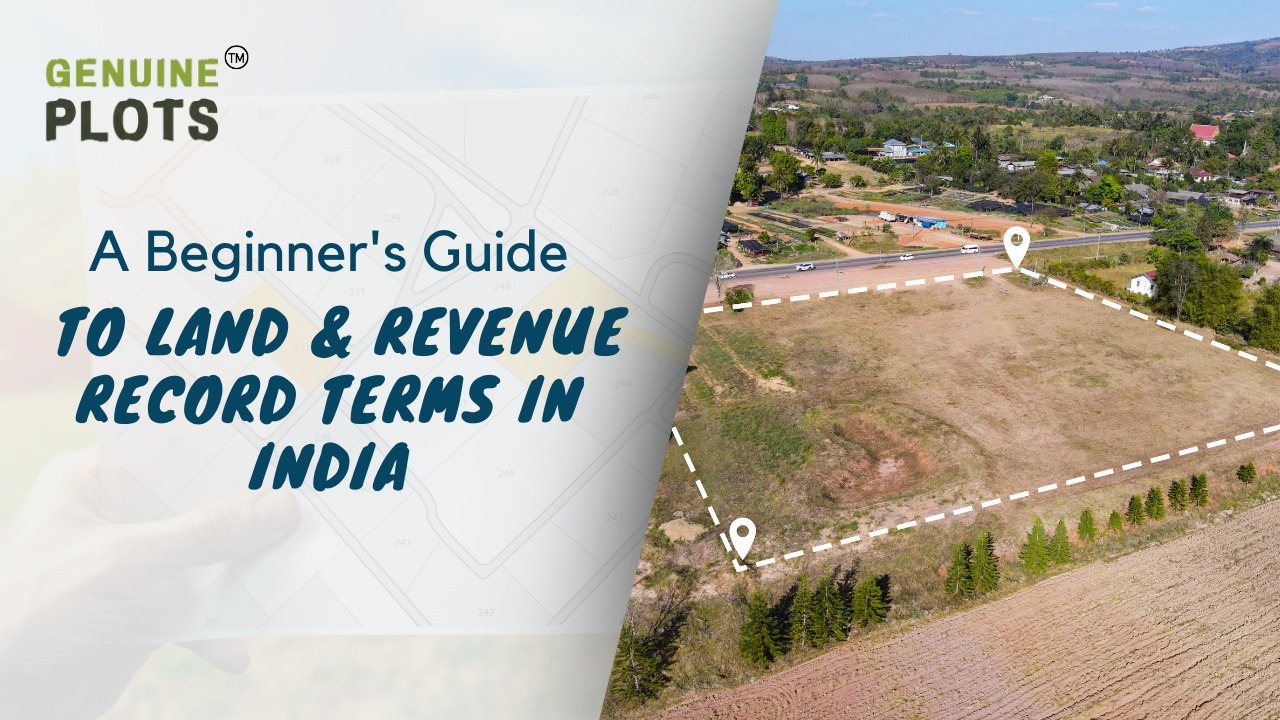
Land transactions can be a labyrinth of confusing terms, especially when checking records online. In this simplified guide, Genuine Plots unravels key terms, empowering you to make informed decisions and ensuring smooth navigation through the world of land transactions. Let's embark on this journey together, where understanding land records becomes as easy as a walk in the park.
Jamabandi
Nakal
Khata
Khasra or DAG Number
Khewat
Mauza
Bainama
Khatauni
Patta
Khudkasht
Embarking on a land transaction journey can be daunting, but armed with these simplified explanations, you'll be better equipped to decode the complexities of land records.
Prev Post
No previous post available

Buying land in Karnataka, especially around Bangalore, can be a great investment — but it’s very important to know the type of land you are buying and the documents you’ll need. The state government has different rules for different kinds of land, and every buyer must follow the proper checklist before completing the purchase.
There are three main types of land in Karnataka that are allowed for sale:
Agricultural Land, Revenue land, Bangalore Development Authority (BDA) Sites
Each land type comes with its own legal process and list of documents. Let’s go through them one by one.
1. Agricultural Land
Agricultural land is mainly used for farming or growing crops. If someone wants to buy this kind of land for non-farming purposes, they must follow the rules under the Karnataka Land Reforms Act (1961) and the Karnataka Land Revenue Act (1964).
Here’s the checklist of documents required to buy agricultural land in Karnataka:
Stamp Duty Certificate – Proof that stamp duty has been paid.
2. Revenue Land
Revenue land usually refers to land located outside city limits or on the outskirts. The sale of revenue sites outside the municipal corporation limits has been banned since 2013 by the Karnataka government.
However, if the land is within the municipal corporation’s jurisdiction, you can still buy it — but you’ll need the same documents required for agricultural land, plus a few additional ones:
3. Bangalore Development Authority (BDA) Sites
BDA sites are officially developed plots within Bangalore city, approved by the Bangalore Development Authority. These are some of the safest types of land to buy in Bangalore because they come with clear legal backing.
Here’s the checklist for BDA sites:
In Bangalore, properties are classified as ‘A Khata’ and ‘B Khata’.
A Khata properties are legally approved and fully recognised by BBMP.
B Khata properties are not yet approved for layout and do not have full legal protection.
Final Tip
Verify the land type and ownership documents carefully.
Consult a qualified property lawyer for legal verification.
Make sure all taxes and dues are cleared before registration.
Following the proper checklist will help you buy land safely and legally — and protect your investment for the future.
 A Simple Step-by-Step Guide.jpeg)
The Karnataka Land Reforms 2025 have made investments in agricultural lands, one of the major economic investments in Karnataka, far easier and more transparent. These newly developed rules simplify the process and provide clearer guidance for farmers, NRIs, and even non-farmers who wish to own farmland responsibly.
If you're considering investment in farmland this year, here is a step-by-step guide to assist you in making a legally compliant, confident purchase.
Step 1: Assess Your Eligibility
Review your income source, occupation, and background.
Under the 2025 reforms, non-farmers have to fulfil certain conditions.
NRIs should ensure that they have the necessary permissions under Indian law to invest in the agricultural sector.
The first step helps you avoid any legal complications later on and keeps your investment within the framework set up by the state's policies.
Step 2: Land Type and Records Verification
Next, check the type and classification of the land you are to purchase. Find out whether it is an agricultural, organic, or eco-farm land.
It is necessary to check crucial documents like:
RTC (Record of Rights, Tenancy, and Crops). Mutation records, ownership history and encumbrance certificate
This verification helps confirm that the property is legitimate, free from disputes, and suitable for the intended agricultural purpose.
Step 3: Legal Due Diligence and Registration
Utilise the services of a qualified legal expert so that the land is free from all sorts of legal and financial encumbrances. The expert can also help confirm that all documentation complies with the latest Karnataka Land Reforms 2025 requirements.
During registration, make sure:
Step 4: Consider Managed Farmland Options
The managed farmland projects should be a wise and compliant option for investors who seek hassle-free investments.
Step 5: Invest Confidently and Sustainably
In this way, you'll be able to invest in Karnataka agricultural land legally, safely, and responsibly. The reforms of 2025 have opened new avenues for those who want to contribute toward sustainable agriculture and savour financial and lifestyle benefits in the long run. Your aim may be anything from building a source of passive income or supporting organic farming to reconnecting with nature-the Karnataka landscape offers immense promise for responsible and transparent farmland investment.

Owning agricultural land in Karnataka has always been a dream for many, be it for peaceful weekend escapes, sustainable farming, or long-term investment. But until now, buying farmland was not an easy thing to do, especially for non-farmers and NRIs.
Now, with the Karnataka Land Reforms 2025, things have turned out for good. These new rules make it simpler, fairer, and more transparent for people to understand and invest in farmland across the state. It will persuade people toward organic farming and the objectives of responsible ownership with eco-friendly land use, keeping the spirit of agriculture alive.
A Quick Look Back: How It Was Before 2025
To understand the impact of these new reforms, it helps to look at how things were before.
The Karnataka Land Reforms Act, 1961, initially aimed to protect the interests of farmers and to prevent land from being concentrated in a few hands. It had provisions to ensure that agricultural land remained in the hands of those who actually cultivated it.
Under the old system:
It wasn't until 2020 that the state started liberalising some of these restrictions by permitting some non-farmers to invest in structured and managed farmland models. This was perhaps a first step toward more liberal and modern agricultural investment.
Karnataka Land Reforms 2025: What's New?
The 2025 updates go further, with reforms that ease land ownership and enable sustainable, responsible farming.
Here’s what’s changed:
1. Clear Ownership Rules and Eligibility: The law now prescribes the maximum landholding limit, subject to which non-farmers, professionals, and NRIs could invest in farmland. This makes the process fair and regulates land hoarding.
2. Flexible Land Use Options: As such, partial conversion of land is now allowed for projects such as eco-tourism, farmhouses, and organic farming ventures. This means investors can explore multiple legal and sustainable uses for their land.
3. Support for sustainable and organic farming: Subsidies, technical support, and incentives are provided by the government for organic and ecologically friendly agriculture, thus promoting green growth and responsible farming.
4. Simplified Registration and Approval: The purchase of farmland has now become faster and more transparent. The new system ensures smoother registration, mutation, and approval, reducing red tape and delays.
The purchase of farmland has now become faster and more transparent. The new system ensures smoother registration, mutation, and approval, reducing red tape and delays.
These reforms unlock a new era in agricultural investment in Karnataka. The question no longer remains who can buy farmland, but how responsibly and sustainably one uses the land. Whether you are a farmer or an urban investor looking for a peaceful retreat amidst nature, the new Karnataka Land Reforms 2025 make owning farmland simpler, smarter, and more rewarding than ever.

Purchasing agricultural land in Karnataka is not a simple process, as it involves a lot of financial and legal complexities. Before making a purchase, a buyer—whether a farmer, non-farmer, or NRI investor—must comprehend the local ecology, topography, and legal environment. However, the benefits could be abundant for those who follow all legal requirements and do their research.
Why Invest in Karnataka Agricultural Land?
Karnataka has emerged as one of the most promising states in India for investment in agriculture. The state comprises diverse agroclimatic zones, advanced irrigation facilities, and progressive government policies-ideal for the growth of small and large-scale agriculture.
Some of the key reasons include:
1. Favourable Agroclimatic Conditions
The varied climate of Karnataka ranges from being conducive for coffee, spices, and millets to fruits and vegetables; thus, it provides ample scope to investors for diversification in the agricultural portfolio.
2. Government Support and Policies
The Government of Karnataka has introduced several investor-friendly reforms and schemes related to agricultural development, making the process of land acquisition and its associated documentation easier than ever.
3. Revised Land Reforms Act
Recent changes to the Karnataka Land Reforms Act have paved the way for non-farmers and NRIs to invest in farmland legally. This flexibility has transformed the market, enabling more investors to venture into agricultural activities.
4. Strategic Location and Export Potential
The geographic advantage of Karnataka is its proximity to major ports and export hubs, giving easy access to both domestic and international markets and increasing profitability for agricultural produce.
5. Long-Term and Reliable Profits
Farmland investments offer consistent returns due to the growing demand for locally grown and organic produce.
The Bottom line
Karnataka offers a favourable environment for long-term investment growth, thanks to its diverse agricultural potential, expanding market demand, and supportive government reforms. Investors can make farmland ownership a lucrative and satisfying endeavour by making well-informed decisions and ensuring all legal and environmental considerations are taken into account.
As our world becomes more and more dominated by glass towers and concrete jungles, the bond between people and the earth beneath their feet is breaking. Our skyscrapers become taller every year, but they tend to do so at the expense of the very ecosystems that support life. By moving further away from natural cycles—light, wind, rain, earth—we unknowingly construct environments that suck energy and well-being. It's here that climate-responsive design comes into play, not as a design ethic, but as a responsibility to the planet and to ourselves.
Climate-responsive design, in essence, is about designing buildings with nature, not against it. It understands that architecture is not independent of the environment—architecture breathes, casts shadows, and responds to the climate. By observing the paths of the sun, prevailing winds, rain conditions, and available local materials, architects can design buildings that respond naturally to the climate. Such sensitivity lessens the need for artificial systems to heat, cool, and illuminate, thus reducing energy consumption and carbon emissions.
The strategy is not novel; it finds its roots in conventional buildings that long ago developed organically from the weather. Thick Rajasthani mud walls kept homes cool during the sweltering summer months, while south-facing Kerala roofs with sloped designs easily handled monsoon rains. These conventional treatments showed environmental intelligence long before the word "sustainability" was created. By integrating those lessons with contemporary technology, we can now design spaces that are resilient, effective, and restorative.
In and of itself, climate-responsive design is rewarding. Fresh air, green views, and natural daylight all improve mental and physical well-being. People can re-establish a connection with nature even in urban areas thanks to buildings that breathe and adapt, which enhances the sense of natural cycles.
Lowered energy use relieves strain on grids, neighbourhood water supplies remain filled, and urban heat islands can be reduced by vegetation and reflective surfaces.
At its core, climate-responsive design is more than an architectural fad—it's a path to a harmonious way of being. It pushes us to reevaluate how we use space, building more as partners with the earth and less as conquerors. Design's future lies in learning to live gracefully within nature's constraints rather than trying to control it.



